Key Takeaways
- Prepare documents before cargo arrives in Thailand; do not let the cargo wait for documents.
- Check the HS Code and permits before submitting the entry, as incorrect classification affects taxes and permits.
- Plan all destination expenses (duty + VAT + handling) completely before committing to the shipment.
- Keep a complete set of shipment files in case of retrospective audits.
What is Import Customs Clearance?
Import Customs Clearance is the legal process that foreign goods must undergo before leaving customs custody and entering business circulation in Thailand. This process is not just about submitting documents; it encompasses verifying product classification, evaluating customs value, checking permits, and paying duties, taxes, and VAT as required by law.
Exporters or importers who have never imported before often assume the process ends when the goods reach the port or airport. In reality, goods still under customs custody cannot be sold or distributed. Therefore, clearance time and costs must be factored into the import plan from the beginning.
5 Main Steps of Import Clearance
Step 1 - Prepare Information and Documents: Collect the commercial invoice, packing list, bill of lading or Air Waybill, insurance certificate (if any), certificate of origin, and import permits for regulated goods. Information must match across all documents, including product descriptions, quantity, weight, value, and country of origin.
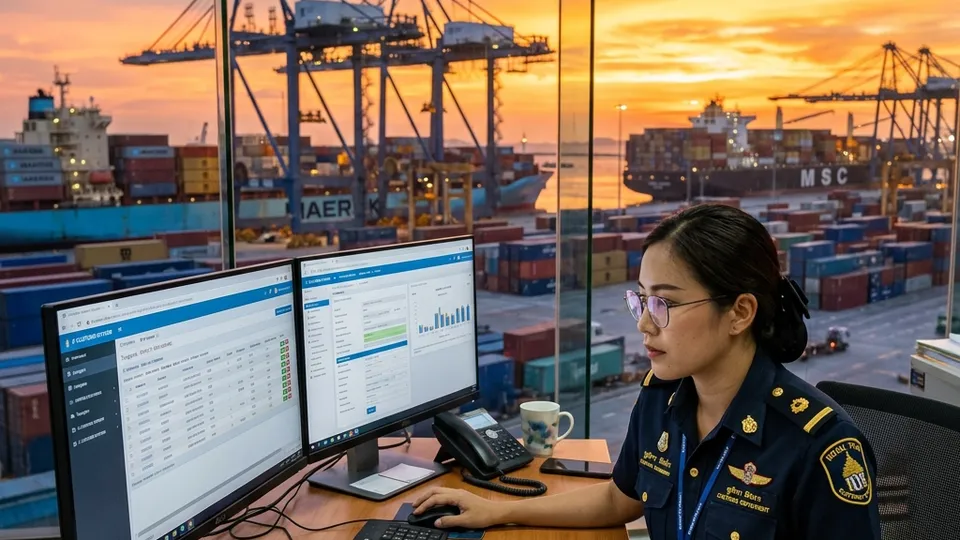
Step 2 - Submit Customs Entry via e-Customs: The Customs Department's e-Customs system receives import declaration data electronically. The declarant must specify the customs tariff code (HS Code), customs value, quantity, weight, country of origin, and importer details.
Step 3 - Inspect Classification and Value: The system evaluates accuracy and routes the entry. The system may opt for automatic release, assign it to an officer for document inspection, or route it for physical cargo inspection, depending on the system's risk assessment.
Step 4 - Pay Duties, Taxes, and VAT: Once verified, the importer must pay import duty based on the tariff rate plus 7% VAT calculated from the CIF value + duty. Certain product types may incur excise taxes or additional special taxes.
Step 5 - Cargo Release: After full tax payment and document inspection approval, the goods will be released and can be transported from the port or airport to the warehouse or final destination.
- Prepare all documents before cargo arrival
- Submit Import Declaration via e-Customs
- Verify HS Code classification and value
- Pay duty + VAT
- Release cargo from customs custody
Looking for Hassle-Free Logistics? Choose LOGISTICS NO LIMIT CO., LTD.!
We specialize in cross-border trucking, customs clearance, and global supply chain management. Secure, compliant, and tracked in real-time.
Contact Our Experts NowFactors Determining Clearance Time
There is no fixed timeframe for how many days customs clearance will take, as it depends on multiple concurrent factors: document accuracy and completeness, product type (general versus regulated goods), clearance channel (Green Lane / Yellow Lane / Red Lane), availability of permits from other agencies like the FDA, Department of Livestock Development, or Department of Agriculture, and the workload of the customs station.
Based on operational experience, shipments with verified documentation, precise HS Codes, no controlled-goods restrictions, and routed through Green Lane receive rapid automated release. Conversely, consignments flagged for physical inspection or lacking regulatory permits enter manual verification procedures, incurring cumulative port storage charges.
Destination Expenses to Plan For
Novice importers often underestimate costs because they forget to include destination fees. Expenses that must be planned for include: import duty (based on classification, ranging from 0% to over 30%), 7% VAT calculated on CIF + duty, port or airport handling fees, customs agent or broker fees, storage fees if cargo awaits clearance for a long time, and inspection fees if routed through the Red Lane.
Performing landed cost calculation in advance and incorporating all destination expenses will help sales and purchasing teams price products and select suppliers more accurately.
Pros and Cons of In-House Clearance vs. Using a Customs Broker
Doing it yourself (In-house): Pros include control over data, understanding actual costs, and building internal capability. Cons include the time required to learn, potential mistakes in classification, permits, or specific product details, which pose risks to key shipments.
Using a Customs Broker: Pros include reduced risk of errors and having experts to check and coordinate, suitable for new shipments or regulated goods. Cons include the cost, and if incomplete data is provided, the broker may submit incorrect information.
An effective approach for many businesses is a hybrid model: use a broker to submit and inspect, while the internal team owns the product data and reviews it collaboratively.
What to Prepare Before Shipment Departure
Preparing before cargo departure reduces destination risks much better than troubleshooting on-site. Checklist items to verify in advance include: checking the product's HS Code from the customs database, verifying if the product requires permits or special standards, requesting a CO or FTA certificate if wishing to claim duty reduction, verifying that the invoice matches the packing list and booking confirmation, and coordinating with the broker or forwarder regarding the arrival notice and document cutoff.
- Verify HS Code in advance
- Check required permits or standards
- Prepare CO / FTA certificate
- Check invoice matches packing list
- Coordinate with broker before cargo arrival
Official Reference Agencies and Regulations
- Thai Customs Department: Electronic paperless declaration entry guidelines and customs clearance procedures.
- Ministry of Commerce & DFT: Regulations on preferential Certificates of Origin (Form CO) and targeted import-export control lists.
Import customs clearance begins with preparing product details and documents, submitting the customs entry via the e-Customs system, checking classification, value, and permits, paying duties and taxes, and awaiting cargo release. Ensuring that invoice, packing list, HS Code, and permit information match from the start helps reduce the likelihood of cargo delays.
Frequently Asked Questions
Q:What factors determine import customs clearance timelines?
A:Clearance timelines depend on document accuracy, tariff classification, regulatory permit readiness, and electronic risk assessment routing (Green/Yellow/Red Lane). Consignments with complete statutory declarations qualifying for Green Lane receive rapid automated customs clearance.
Q:Can I prepare the documents after the cargo has arrived?
A:It is possible but highly risky. Goods under customs custody incur daily storage charges and shipping line demurrage fees. You should prepare and check draft documents before cargo arrival and provide draft documentation to the customs broker for pre-clearance validation well ahead of cargo arrival.
Q:What are the impacts of an incorrect HS Code?
A:An incorrect HS Code affects the tax rate paid, applicable FTA benefits, required permits, and may lead to retrospective audits. If classification errors lead to underpaying tax, you may have to pay the shortfall along with penalties.
Q:What do import destination expenses consist of?
A:Main destination expenses include: import duty according to the HS Code, 7% VAT (calculated from CIF + duty), port/airport handling fees, customs broker fees, storage fees (if any), and cargo inspection fees if routed through the Red Lane.